Practicing What We Preach: The Missing Piece in Health and Safety
There’s an uncomfortable truth in the health and safety world that almost nobody wants to say out loud. We demand healthy habits from workers, expect them to show up fit for duty, and talk endlessly about culture, wellness, and psychological safety. Yet many of the people teaching these principles don’t follow them themselves.
I’ve worked in this field for years, and I’ve seen safety professionals who can’t walk up a flight of stairs without stopping for air. I’ve watched people deliver presentations on wellness while looking like they’re on the edge of a health crisis. And now the newest trend is seeing people promote psychological safety while ignoring the physical and mental habits that actually support it.
This isn’t about perfection. It’s about credibility.
Because at the end of the day, people don’t follow what we say.
They follow who we are.
When Credibility Walks Into the Room Before You Do
A few years back, I brought a newly hired health and safety coordinator to visit one of our branches. He was a big guy, somewhere around 400 pounds, and his stomach hung out from under his shirt. Before he even said a word, the branch manager pulled me aside.
He looked me straight in the face and said, “Dan… you can’t be serious. You’re sending this guy to talk about health and safety? You think anyone will follow him?”
It was blunt. It was harsh. It was uncomfortable.
But he wasn’t wrong.
Leadership is influence, and influence starts before you open your mouth.
If your physical presence sends the opposite message of the job you’re supposed to be doing, you’re already starting from behind.
That moment changed how I looked at our profession.
When Health Affects Performance: The Auditor Who Couldn't Finish the Day
Another example hit even harder. I once hired an external COR auditor to review our operations. This is someone whose job requires walking, climbing multiple flights of stairs, and touring active work environments.
By midday, he physically couldn’t continue.
He was too fatigued to finish the site inspections.
Too many stairs.
Too much movement.
Not enough personal conditioning to handle the demands of the job.
We had to stop the audit.
That moment reinforced something important:
Health isn’t optional in this profession. It’s part of the job.
If an auditor can’t physically navigate the work environment, how can they properly evaluate risk?
How can they model safe behavior?
How can they lead with authority and credibility?
These aren’t judgmental questions, they’re practical ones.
The Fitness Instructor Analogy
If you hired a personal trainer and they were visibly unhealthy, what would you think?
If you hired a financial advisor who was drowning in debt, would you take their advice?
Of course not.
Yet in the safety world, we accept that someone can call themselves a professional, even an expert, while ignoring their own health and well-being. And we’re surprised when workers roll their eyes, tune out, or quietly dismiss us.
Credibility matters.
Your example matters.
Your habits matter.
The Foundation of Safety Starts With You
A lot of people think health and safety starts with policies, inspections, or orientation slides. It doesn’t.
It starts with the person delivering the message.
You can’t expect workers to care about safe work habits if you don’t demonstrate healthy habits yourself.
Health and safety professionals should be:
Alert
Energetic
Mobile
Balanced
Practicing what they preach
You don’t need to be a pro athlete. You don’t need a six-pack. You just need to show that you value health in the same way you’re asking others to value it.
Where Psychological Safety Fits In
There’s another layer people miss.
Psychological safety has become a big talking point in conferences: trust, communication, risk-free dialogue. All good things. But here’s the part nobody talks about…
Psychological safety depends on psychological health.
And psychological health depends on physical health.
You can’t build resilience, focus, or emotional stability if:
You’re exhausted
You eat poorly
You abuse alcohol or drugs
You never exercise
Your stress is unmanaged
You’re running on fumes
That’s why I created the GreenSpine Model of Psychological Safety — to show that psychological safety isn’t a floating concept you stick on a poster. It’s built on a foundation of physical and mental health.
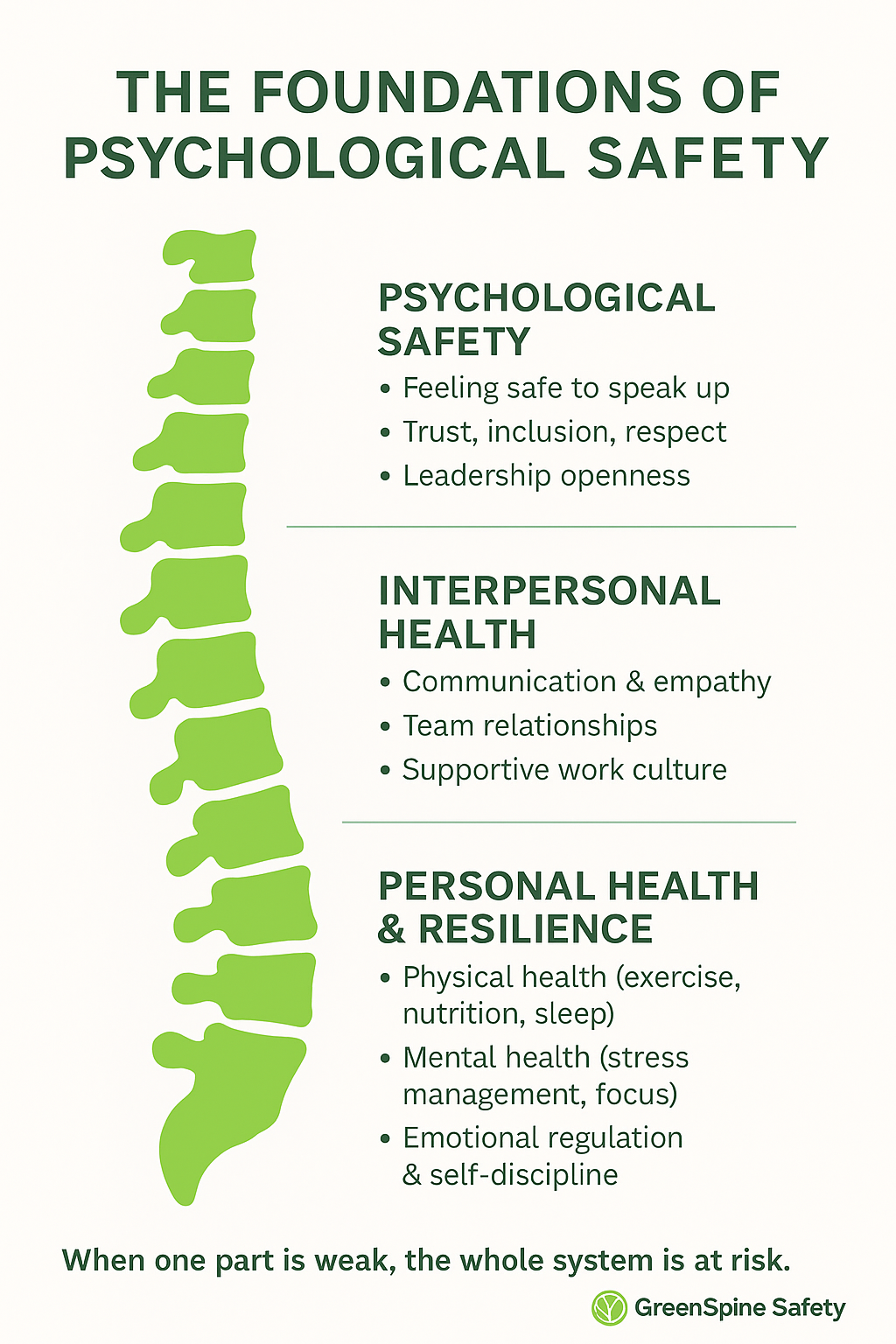
If the foundation is weak, everything above it becomes unstable.
Leadership by Example
Every safety professional, coordinator, manager, or director should ask themselves one question:
“If someone looked at me, before hearing me speak, would they believe I live the message I’m trying to teach?”
If the answer is no, it’s not about shame. It’s about responsibility.
We expect workers to be fit for duty.
We expect them to use proper PPE.
We expect them to take care of themselves.
We have the same obligation.
In this field, you don’t need to be perfect. But you should be intentional. When you take care of yourself, you:
Think clearer
Respond better
Lead more effectively
Model discipline
Earn respect
Make psychological safety real
Closing Thought
The best safety leaders I’ve ever met aren’t the ones who memorize every regulation. They’re the ones who live their message.
They show up with energy.
They show up with integrity.
They show up healthy enough to handle the demands of the job.
Because safety isn’t only about what we teach.
It’s about who we are when we walk onto a site.
Call to Action
Want support building a stronger, healthier, more credible safety culture in your organization?
GreenSpine Safety Solutions can help you strengthen the foundation your entire safety program stands on.