The Safety Plateau: Why Your Safety Program Stops Improving (And What to Do Next)
Most companies don’t fail because they ignore safety.
They fail because they stop improving.
The Pattern I Keep Seeing
Across forestry, construction, and manufacturing, I continue to see the same pattern.
A company starts with a high-risk profile.
They implement a health and safety program.
And it works.
Incidents drop.
Engagement improves.
Supervisors start having better conversations.
They go from a “10” down to a “4.”
That’s a major win.
But then……….they stop.
The Plateau Effect
Here’s what happens next:
The same meetings continue
The same forms are used
The same conversations repeat
And performance flatlines.
Sometimes for 3 years.
Sometimes for 10.
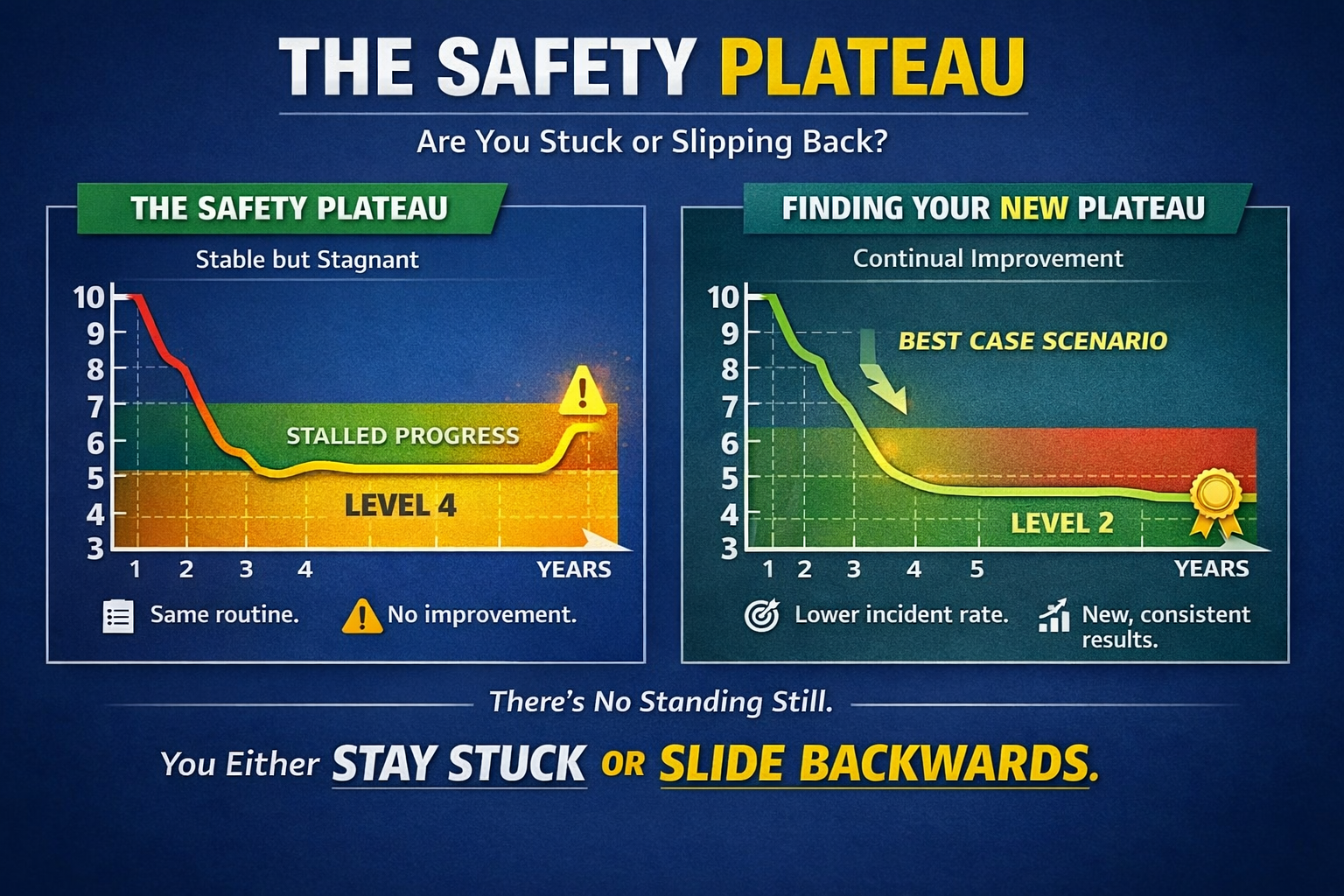
📊 The Safety Plateau vs. Lowering the Plateau
Why Plateaus Are a Hidden Risk
Most organizations think a plateau means stability.
It doesn’t.
A plateau means:
You’ve extracted all value from your current system
Your controls are no longer evolving
Your exposure is slowly increasing
You’re not holding the line.
You’re drifting.
The Warning Sign Most Companies Miss
The biggest red flag is inconsistency.
You’ll see it in your data:
A spike year (injuries jump back up)
Then a recovery
Then another spike
That’s not bad luck.
That’s a system under strain.
What’s Actually Breaking Down
On paper, everything looks compliant:
Policies exist
COR audit passes
Safety meetings are happening
But in reality:
Procedures aren’t followed consistently
Supervisors are making operational trade-offs
Leadership messaging doesn’t match behaviour
This is where most systems fail.
Not in design, but in execution.
The “All Show, No Go” Problem
Every plateaued system has it.
Leaders who:
Speak strongly about safety in meetings
But tolerate shortcuts in operations
Workers see this immediately.
And once that credibility gap opens, your system starts to erode.
Breaking Through the Plateau
Getting from a “4” to a “2” is not about more documentation.
It requires a shift:
Operational Accountability
Supervisors are held accountable for how work is actually done, not just reported.
Leadership Alignment
What’s said in meetings matches what’s accepted in the field.
Verification, Not Assumption
You validate behaviours, not just paperwork.
System Evolution
You actively improve, not maintain.
What “Good” Actually Looks Like
Top-performing organizations don’t eliminate plateaus.
They lower them over time.
Year 1–2: Drop from 10 → 4
Year 3–4: Drop from 4 → 2
Maintain consistency at the new level or drop to 1
That’s real performance.
Not spikes.
Not luck.
Not paperwork.
This Applies Beyond Safety
This same pattern shows up in:
Fitness
Business
Leadership
Everyone hits a plateau.
But once you’re there:
Doing the same things will never move you forward.
You either:
Evolve
Or regress
There is no neutral.
Final Thought
If your safety performance feels stable, but not improving, you’re likely plateaued.
And that’s the point where most organizations either:
Take the next step forward
orSlowly lose control
Call to Action
If you want a clear picture of where your system actually stands, start with a structured gap assessment.
Because the issue usually isn’t what’s written down.
It’s what’s actually happening in your operation.
Call Greenspine Safety Solutions for a free gap assessment today!
If you’re working toward COR certification…….